
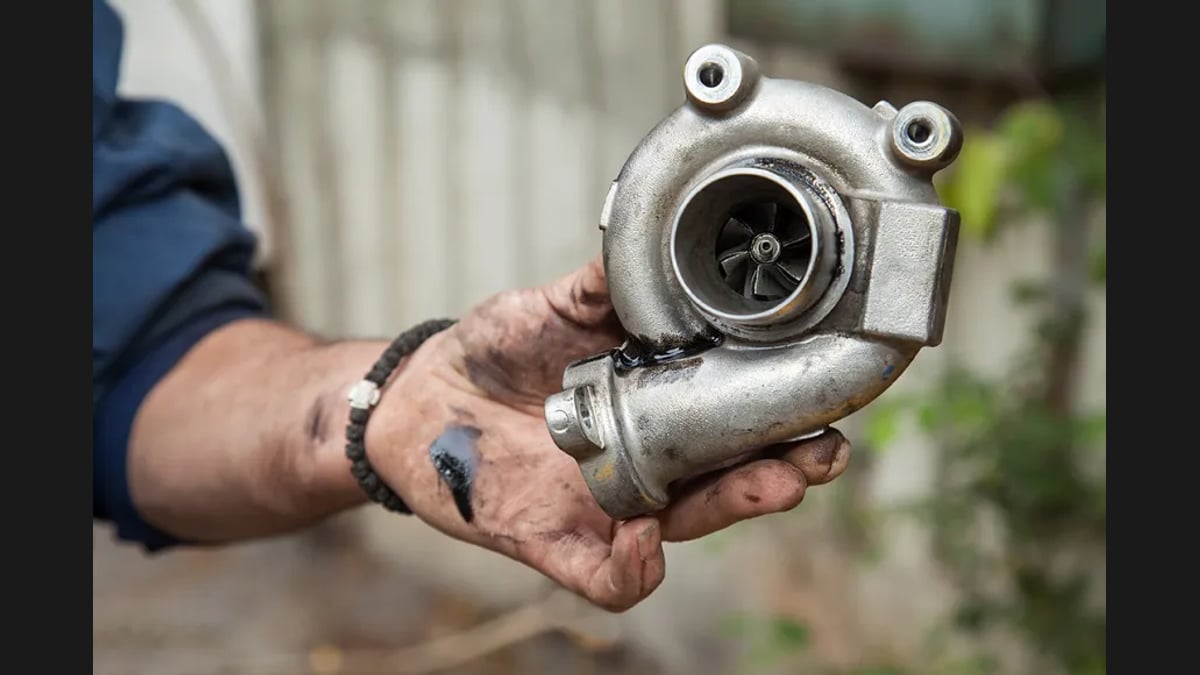
A turbocharger rarely fails without warning. It gives you signals for days or weeks before it finally lets go — and the difference between catching it early and ignoring it is often the difference between replacing a turbo and rebuilding an entire engine.
Here are the seven symptoms every driver, mechanic and fleet owner should know.
1. Loss of power and slow acceleration
This is usually the first sign. The vehicle feels heavy, struggles on inclines, and takes much longer to pick up speed. What's happening is simple: the turbo is no longer pushing enough compressed air into the engine, so your diesel is running closer to a naturally aspirated engine — with far less power.
2. A loud whistling or siren-like noise
A healthy turbo makes a smooth, low sound. A failing one whistles, screeches or sirens, and the noise gets louder as you accelerate. This usually means worn bearings or a damaged compressor wheel. Once you hear this, stop driving hard — a spinning wheel that touches its housing can shatter in seconds.
3. Blue smoke from the exhaust
Blue smoke means engine oil is burning. In a turbo, it points to failed oil seals letting lubricant leak into the compressor or turbine side. It's most visible when the engine is revved after idling.
4. Black smoke from the exhaust
Black smoke means incomplete combustion — too much fuel for the available air. A turbo that isn't producing boost, or a leak in the pipework between turbo and intake manifold, both cause this.
5. Check engine light / underboost fault codes
Modern engines monitor boost pressure constantly. Codes for underboost, overboost or turbocharger inefficiency are a direct message from the ECU that the turbo isn't performing to spec. Don't clear the code and keep driving — scan it properly.
6. Rising oil consumption
If you're topping up oil more often with no visible leak on the ground, the oil may be going through the turbo seals and out of the exhaust.
7. Excessive exhaust gas temperature or overheating
When the turbo can't move exhaust gas efficiently, temperatures climb. Sustained high EGT damages pistons, valves and the turbo itself.
Why these symptoms are dangerous to ignore
Every one of these signs can escalate to catastrophic engine failure. A compressor wheel that breaks sends metal fragments straight into the engine. Oil starvation seizes the shaft at over 100,000 RPM. What starts as a whistle can end as a rebuild.
An important diagnostic note
Many turbochargers get replaced when they were never the real problem. A blocked air filter, a restricted DPF, a leaking intercooler hose or a failing injector can all produce identical symptoms. Before replacing the turbo, check the air intake, the oil supply and drain lines, and the exhaust side for restriction. If you fit a new turbo without fixing the root cause, the new unit will fail too — usually fast.
What to do next
If your turbo is confirmed faulty, you have two options: replace the complete turbocharger, or fit a CHRA core assembly if the housings are undamaged. Cummins also publishes a useful turbocharger troubleshooting matrix worth checking before you replace anything.
Turbo Tech Engineers has supplied turbochargers, CHRAs and diesel engine parts since 1996, from New Delhi and Amritsar. We stock units for Caterpillar, Cummins, Bosch, Delphi, IHI and more, covering trucks, buses, excavators, tractors, gensets and industrial engines. Browse our product categories.
Send us your part number, engine model or a photo of the old unit on WhatsApp and we'll confirm the right replacement.
Call or WhatsApp: +91 96465 22590
Email: turbotechdelhi@gmail.com