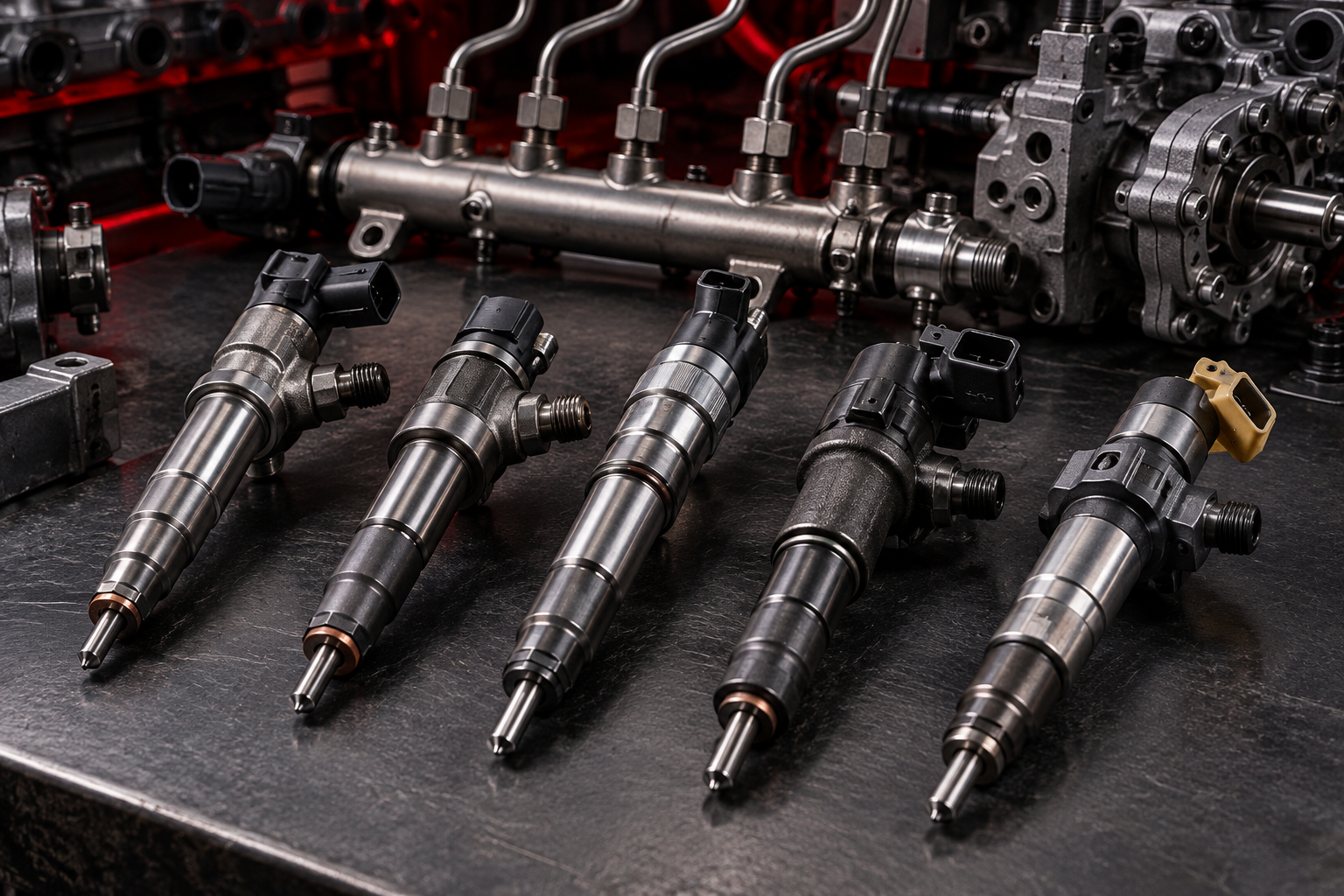
Common rail diesel injectors are precision components responsible for delivering accurately controlled quantities of fuel into the engine cylinders. They operate at very high pressures and must control fuel quantity, timing and spray characteristics with extreme precision.
When a common rail injector begins to wear or develops a fault, the engine may experience rough idling, hard starting, poor acceleration, increased fuel consumption, excessive smoke, engine misfires or other performance problems.
However, these symptoms do not always mean that the injector itself has failed. Problems with fuel quality, fuel filtration, the high-pressure pump, electrical control or other engine components can produce similar symptoms.
For this reason, proper diagnosis is important before replacing an expensive diesel injector.
WHAT IS A COMMON RAIL INJECTOR?
A common rail injector is an electronically controlled diesel fuel-injection component that delivers high-pressure fuel into an engine's combustion chamber.
The high-pressure fuel pump supplies fuel to the common rail, which acts as a high-pressure accumulator. Individual injectors then receive fuel from the rail and inject a precisely controlled quantity into each cylinder.
Modern common rail injectors can perform multiple injection events during a single combustion cycle. This allows the engine control system to manage fuel quantity and injection timing more precisely, supporting engine performance, fuel efficiency and emissions control.
Delphi states that modern common rail injectors can operate at pressures up to 30,000 psi and use extremely small internal clearances, making them highly sensitive to contamination and wear.
COMMON RAIL INJECTOR PROBLEMS
Common rail injector problems can develop because of several factors, including:
Fuel contamination
Water contamination
Poor fuel filtration
Normal mechanical wear
Incorrect installation
Damaged injector components
Electrical faults
Control-valve problems
Nozzle wear or contamination
Improper servicing
Incorrect sealing or installation
Bosch identifies poor fuel filtration, fuel contamination and incorrect installation among important causes of common rail injector failure.
8 COMMON SYMPTOMS OF A FAULTY COMMON RAIL INJECTOR
ROUGH ENGINE IDLING
A faulty injector may deliver an incorrect or inconsistent quantity of fuel to a cylinder.
This can result in uneven combustion and an unstable engine idle.
In severe cases, engine speed may fluctuate significantly or the engine may stall.
Rough idle is one of the commonly reported symptoms of common rail injector problems.
HARD STARTING
A diesel engine may become difficult to start when an injector is not delivering the required amount of fuel or when excessive internal leakage affects fuel-system pressure.
However, hard starting can also be caused by the battery, glow plugs, fuel filter, fuel supply, high-pressure pump or other components.
Injector testing should therefore be performed before replacing the injector.
LOSS OF POWER
A damaged or poorly performing injector can reduce the amount or quality of fuel delivered to a cylinder.
The result may be reduced engine power, poor acceleration or difficulty maintaining performance under load.
Loss of power can also be caused by turbocharger, fuel-pressure, DPF, EGR or air-intake problems.
ENGINE MISFIRE
If an injector fails to deliver the correct quantity of fuel, the affected cylinder may not produce the expected amount of power.
This can result in an engine misfire or uneven engine operation.
Delphi identifies misfire and poor acceleration among possible symptoms of common rail injector problems.
INCREASED FUEL CONSUMPTION
A faulty injector can disturb the intended fuel quantity and combustion process.
This can contribute to increased fuel consumption.
However, fuel economy can also be affected by driving conditions, tyre pressure, air-intake problems, turbocharger faults, DPF regeneration and other engine issues.
EXCESSIVE EXHAUST SMOKE
Incorrect fuel delivery or poor atomization can affect combustion and increase exhaust smoke.
Depending on the failure mode and engine configuration, the smoke may appear black, white or otherwise abnormal.
Modern emission-control systems can change how visible these symptoms are, so smoke alone should not be used to identify a faulty injector.
ENGINE KNOCK OR UNUSUAL COMBUSTION NOISE
Injection timing and fuel quantity affect the combustion process.
If an injector is not operating correctly, combustion may become abnormal and produce unusual knocking or rattling sounds.
Other mechanical and fuel-system problems can produce similar noises, so diagnosis is required.
CHECK ENGINE LIGHT
Modern diesel engines continuously monitor fuel injection and engine-management parameters.
An injector or related fuel-system fault can trigger a warning light and store diagnostic trouble codes.
A diagnostic code can help identify the affected system, but it does not always prove that the injector itself is defective.
WHY DO COMMON RAIL INJECTORS FAIL?
FUEL CONTAMINATION
Diesel fuel contamination is one of the major threats to common rail fuel systems.
Small particles can damage precision internal surfaces, while water contamination can contribute to corrosion and other fuel-system problems.
Because modern injectors have extremely small internal clearances, effective fuel filtration is essential. Delphi specifically identifies particle and water contamination as causes of common rail injector failure.
POOR FUEL FILTRATION
The fuel filter protects the injection system from contaminants.
If the wrong filter is used, the filter is overdue for replacement or filtration is inadequate, contaminants can reach sensitive injector components.
Bosch recommends using filters meeting the required original-equipment filtration specification and following the recommended replacement interval.
INCORRECT INSTALLATION
Common rail injectors require correct installation procedures.
Incorrect sealing, improper tightening or contamination during installation can result in poor injector performance or premature failure.
The injector seat, sealing components and installation procedure should follow the manufacturer's specifications.
NORMAL WEAR
Common rail injectors operate repeatedly under high pressure.
Over time, internal components can wear and injector performance can change.
Wear can affect fuel quantity, injection timing, return flow and spray characteristics.
HOW TO TEST A COMMON RAIL INJECTOR
Injector symptoms should be confirmed with appropriate diagnostic testing.
Depending on the vehicle and injector type, a professional diagnostic process may include:
Diagnostic scan
Injector correction or balance data
Return-flow or leak-off testing
Electrical testing
Injector bench testing
Spray-pattern testing
High-pressure fuel-system testing
Physical inspection
The exact testing procedure depends on the injector manufacturer and application.
STEP 1: SCAN FOR DIAGNOSTIC FAULT CODES
The first step is often to connect suitable diagnostic equipment and check for stored fault codes.
Fault codes can help identify the fuel-injection system or cylinder requiring further investigation.
However, a fault code should be treated as a diagnostic starting point rather than automatic proof that the injector needs replacement.
STEP 2: CHECK INJECTOR PERFORMANCE
If injector operation is suspected, the injector should be evaluated using the appropriate testing method.
Depending on the system, this can involve checking injector correction values, return flow or other available parameters.
STEP 3: PERFORM A LEAK-OFF OR RETURN-FLOW TEST
A return-flow test measures the quantity of fuel returning from the injector.
Excessive return flow can indicate an internal injector problem, although the acceptable value depends on the specific injector and engine.
Delphi recommends back-leak measurement as part of the diagnostic process for identifying potentially faulty common rail injectors.
STEP 4: CHECK THE HIGH-PRESSURE PUMP
A common rail injector problem can sometimes actually be caused by inadequate fuel pressure from the high-pressure pump.
For this reason, rail pressure should also be evaluated where appropriate.
Delphi's diagnostic procedure specifically recommends checking common rail pump function when injector-related problems are suspected.
STEP 5: CHECK ELECTRICAL OPERATION
Common rail injectors may use solenoid or piezoelectric technology depending on the application.
Electrical testing can identify problems such as open circuits, short circuits or other electrical faults.
The correct testing procedure depends on the injector design.
CAN A COMMON RAIL INJECTOR BE REPAIRED?
Some diesel injectors can be professionally repaired or rebuilt using appropriate replacement components and calibration equipment.
Possible service components can include:
Injector nozzle
Control valve
Seals
Internal wear components
Other manufacturer-specific components
However, not every injector fault is repairable.
An electrical failure or severe internal damage may require injector replacement depending on the injector design and manufacturer's repair procedures.
Professional injector repair should include appropriate testing and calibration after assembly.
WHEN SHOULD YOU REPLACE A DIESEL INJECTOR?
An injector should generally be replaced when testing confirms that it is outside the required operating specifications or when it is damaged beyond economical or approved repair.
Before replacing an injector, the cause of the failure should also be investigated.
If contaminated fuel caused the original injector problem, simply installing a new injector without addressing the contamination can result in another failure.
The fuel filter, fuel quality, fuel system and other injectors should be inspected where appropriate.
SHOULD YOU REPLACE ONE INJECTOR OR ALL OF THEM?
A faulty injector does not automatically mean that every injector on the engine needs to be replaced.
If testing identifies one defective injector and the remaining injectors meet the required specifications, replacing the affected injector may be appropriate.
Delphi specifically notes that testing can identify individual faulty injectors, allowing individual replacement rather than automatically replacing the complete set.
The correct approach depends on the vehicle, engine condition, injector specifications and professional test results.
BOSCH COMMON RAIL INJECTORS
Bosch is one of the major manufacturers of common rail diesel injection components.
Bosch common rail injectors are used across passenger cars, commercial vehicles and other diesel applications.
Bosch injector identification commonly includes a Bosch part number along with additional calibration or application information.
When purchasing a replacement Bosch injector, the complete number from the original injector should be checked rather than relying only on the vehicle model.
DELPHI COMMON RAIL INJECTORS
Delphi also manufactures common rail diesel injection systems and injectors for a wide range of applications.
Delphi injector references can appear in different formats depending on the generation and application.
The complete reference from the original injector should therefore be used when identifying a replacement.
HOW TO CHOOSE THE CORRECT COMMON RAIL INJECTOR
Before purchasing a replacement injector, verify:
Injector part number
Manufacturer
Engine model
Vehicle or equipment application
Fuel system
Injector type
Original equipment reference
Calibration or coding requirements
Physical and electrical configuration
A vehicle model alone may not be enough to identify the correct injector.
Different engine versions can use different injectors even when they are installed in the same vehicle model.
WHY INJECTOR PART NUMBERS MATTER
The injector part number is one of the most important pieces of information when sourcing a replacement.
Two injectors may look almost identical while having different flow characteristics, nozzle specifications, electrical characteristics or calibration requirements.
For this reason, always provide the complete part number from the original injector when requesting a replacement.
COMMON RAIL INJECTOR MAINTENANCE TIPS
Use clean, good-quality diesel fuel.
Replace the fuel filter at the recommended interval.
Use the correct fuel filter specification.
Prevent water and dirt from entering the fuel system.
Keep injector installation areas clean.
Use new sealing components where required.
Follow the manufacturer's installation torque specifications.
Do not ignore rough idling, hard starting or unusual smoke.
Test injectors before replacing components unnecessarily.
Investigate the cause of repeated injector failures.
WHY PROFESSIONAL DIAGNOSIS MATTERS
Common rail injection systems operate at extremely high pressures and contain precision components.
A symptom such as low power can be caused by an injector, high-pressure pump, turbocharger, DPF, EGR system, fuel filter or another component.
Replacing parts without testing can therefore become expensive.
A systematic diagnostic process helps identify the actual cause and allows the correct component to be repaired or replaced.
FINAL THOUGHTS
Common rail injectors are essential to modern diesel engine performance. Their ability to precisely control fuel delivery helps modern diesel engines achieve efficient combustion and meet increasingly demanding performance and emissions requirements.
When an injector begins to fail, symptoms can include rough idle, hard starting, poor acceleration, misfire, increased fuel consumption, smoke, unusual combustion noise and warning lights.
However, these symptoms can have several possible causes.
Proper diagnosis should therefore come before injector replacement. Diagnostic scanning, return-flow testing, electrical checks, fuel-pressure testing and professional injector testing can help identify the actual problem.
When ordering a replacement injector, always verify the complete part number, engine application and manufacturer specification.
TurboTech Engineers supplies common rail diesel injectors and related fuel-injection components from manufacturers including Bosch and Delphi for a range of diesel applications.
For the correct replacement, provide the original injector part number and application details before ordering.