
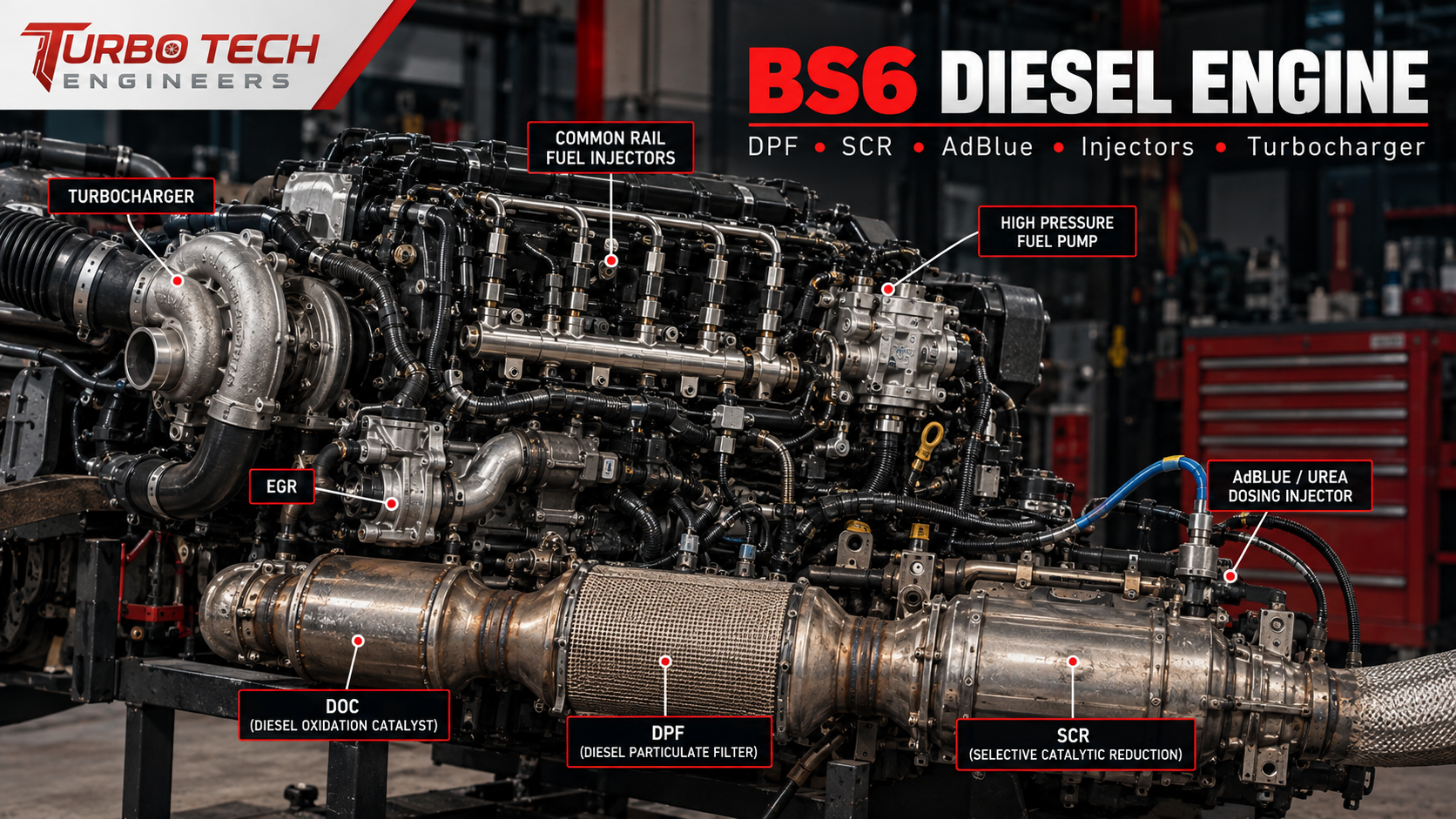
BS6 diesel engines introduced major advances in fuel injection and emission-control technology. Compared with older diesel engines, modern BS6 systems use more electronically controlled components to improve combustion and reduce harmful emissions.
Depending on the vehicle or equipment, a BS6 diesel engine can include a high-pressure common rail fuel injection system, electronically controlled injectors, turbocharging, exhaust gas recirculation, a diesel particulate filter and selective catalytic reduction with AdBlue or diesel exhaust fluid.
These technologies allow diesel engines to meet increasingly strict emission requirements, but they also make diagnosis and maintenance more complex.
WHY ARE BS6 DIESEL ENGINES DIFFERENT?
The transition to BS6 required manufacturers to introduce more advanced emission-control technologies. India's transition to BS6 brought technologies such as diesel particulate filters, selective catalytic reduction and exhaust gas recirculation into modern diesel applications.
At the same time, modern diesel fuel systems rely on electronically controlled high-pressure injection. This means components such as fuel injectors, high-pressure pumps, sensors and control valves must work together accurately.
The result is a cleaner and more technologically advanced diesel engine, but faults in one system can sometimes affect the operation of another.
COMMON BS6 DIESEL ENGINE PROBLEMS
BS6 diesel problems can originate from the fuel injection system, turbocharger, air-intake system or exhaust after-treatment system.
Common issues include:
DPF blockage or excessive soot loading
SCR or AdBlue system faults
Poor diesel injector performance
High-pressure fuel-system problems
Turbocharger performance issues
EGR-related problems
Reduced engine power
Poor fuel economy
Difficulty starting
Warning lights and diagnostic fault codes
Understanding which system is responsible is important before replacing an expensive component.
WHAT IS A DPF AND WHY DOES IT MATTER?
A Diesel Particulate Filter, commonly called a DPF, is an exhaust after-treatment component designed to capture particulate matter from diesel exhaust.
As soot accumulates inside the filter, the vehicle's emission-control system must periodically reduce the accumulated soot through a regeneration process.
Short trips, low-speed operation and operating conditions that prevent the exhaust from reaching the required temperature can contribute to regeneration problems in some vehicles.
A DPF warning should therefore not simply be ignored. Continued operation with an overloaded or damaged filter can lead to reduced engine performance and potentially expensive repairs.
COMMON DPF PROBLEMS
Some common DPF-related symptoms include:
DPF warning light
Reduced engine power
Increased fuel consumption
Frequent regeneration
Regeneration that does not complete
Engine warning light
Reduced performance or limp mode
However, a DPF warning does not automatically mean that the DPF itself needs replacement. The cause can involve the exhaust temperature, sensors, fuel injection, EGR system or other components.
WHAT IS SCR AND HOW DOES ADBLUE WORK?
Selective Catalytic Reduction, or SCR, is an exhaust after-treatment technology used to reduce nitrogen oxide emissions in applicable diesel engines.
SCR systems use a diesel exhaust fluid commonly known as AdBlue or DEF. The fluid is injected into the exhaust system, where it participates in a chemical process that helps convert nitrogen oxides into nitrogen and water.
An SCR system can include an AdBlue tank, pump, dosing equipment, injector, sensors, wiring and an electronic control system.
This means that a fault in the AdBlue dosing system can trigger warning messages or affect vehicle operation.
COMMON ADBLUE AND UREA DOSER PROBLEMS
Possible AdBlue or urea-system problems include:
AdBlue warning messages
Urea dosing faults
AdBlue pump problems
Urea doser or injector faults
Blocked or contaminated dosing components
Sensor-related faults
Wiring or electrical problems
Incorrect fluid quality
Reduced performance or restricted operation after a system fault
A fault in the AdBlue system should be diagnosed according to the vehicle manufacturer's procedure. Replacing the doser or pump without identifying the underlying problem can result in unnecessary expense.
COMMON RAIL INJECTOR PROBLEMS IN BS6 DIESEL ENGINES
The fuel injection system is another critical part of a modern diesel engine.
Common rail injectors operate with highly precise fuel metering and electronic control. The engine control unit determines when and how much fuel should be injected based on operating conditions.
Injector problems can result from wear, contamination, poor fuel quality, fuel-system problems or other mechanical and electrical faults.
Possible symptoms include:
Rough engine idle
Hard starting
Loss of power
Poor acceleration
Increased fuel consumption
Excessive smoke
Engine knocking or abnormal combustion noise
Injector-related fault codes
Before replacing an injector, the complete fuel system should be considered. A high-pressure pump problem, fuel contamination or excessive injector return flow can produce symptoms that may initially appear to be an injector fault.
BS6 DIESEL TURBOCHARGER PROBLEMS
Turbocharging is important because modern diesel engines rely on controlled air supply to support efficient combustion and performance.
A turbocharger problem can cause:
Loss of engine power
Poor acceleration
Unusual turbocharger noise
Excessive smoke
Poor boost pressure
Oil leakage
Reduced fuel efficiency
A turbocharger should not automatically be replaced simply because the engine has low power.
Air-intake restrictions, exhaust restrictions, boost leaks, actuator problems, lubrication issues, EGR problems and fuel-system faults can also affect turbocharger performance.
This is why proper diagnosis is important before purchasing a replacement turbocharger or CHRA.
WHY BS6 DIESEL ENGINES CAN BE MORE DIFFICULT TO DIAGNOSE
A modern diesel engine contains multiple systems that operate together.
For example, poor engine performance could be related to:
Fuel injection
Turbocharger boost
EGR operation
DPF condition
SCR operation
Air intake
Fuel pressure
Electronic sensors
Engine control software
Because these systems interact, replacing one component based only on a symptom can fail to solve the actual problem.
A professional diagnosis should consider fault codes, live data, fuel pressure, injector performance, boost pressure and the condition of the relevant emission-control components.
HOW TO REDUCE BS6 DIESEL PROBLEMS
Proper maintenance is one of the most effective ways to reduce fuel-system and emission-system problems.
Use good-quality diesel fuel from reliable sources.
Replace fuel filters according to the manufacturer's recommended service interval.
Use the correct engine oil specified for the vehicle, particularly where a DPF is fitted.
Do not ignore warning lights.
Avoid repeatedly interrupting a vehicle's required regeneration process.
Use only the specified AdBlue or DEF where an SCR system is fitted.
Keep the fuel and AdBlue systems free from contamination.
Investigate repeated injector or turbocharger failures rather than repeatedly replacing components.
Use the correct replacement part number for injectors, pumps, turbochargers and emission-system components.
WHEN SHOULD A BS6 DIESEL COMPONENT BE REPLACED?
Replacement should normally follow diagnosis rather than symptoms alone.
A faulty injector may require replacement or professional repair depending on its condition and design.
A turbocharger may require replacement, CHRA replacement or repair depending on the source of the failure and the condition of the assembly.
A DPF may require regeneration or professional cleaning in some circumstances, while a damaged filter may require replacement.
An AdBlue pump or urea doser should be replaced when testing confirms that the component has failed and the underlying cause has been addressed.
The correct approach depends on the vehicle, engine, component and manufacturer's specifications.
HOW TO CHOOSE THE CORRECT DIESEL ENGINE PART
Part-number verification is particularly important for BS6 diesel components.
Before ordering a replacement component, verify:
Original part number
Engine model
Vehicle or equipment application
Fuel injection system
Emission standard
Component type
Electrical and physical configuration
Applicable cross-reference numbers
Using only the vehicle name may not be sufficient because the same vehicle model can have different engines, fuel systems and emission-control configurations.
CONCLUSION
BS6 diesel technology has made modern diesel engines cleaner and more electronically controlled, but it has also increased the complexity of the fuel injection and emission-control systems.
DPF, SCR, AdBlue, EGR, common rail injectors, high-pressure fuel pumps and turbochargers all have important roles in modern diesel operation.
When a BS6 diesel engine develops a problem, identifying the correct system and diagnosing the underlying cause is more important than simply replacing parts based on symptoms.
For replacement and repair applications, always verify the original part number, engine specification and vehicle or equipment application before ordering.
TurboTech Engineers provides diesel fuel-system and engine components including common rail injectors, fuel injection pumps, turbochargers and related diesel components for a wide range of applications.